Edgewater is small, but the water that reaches it is not. Rain from three cities and Denver drains toward Sloan's Lake, and the streets in between have a long record of flooding.
Key takeaways
- Sloan's Lake receives runoff from 2,250 acres in Lakewood, Wheat Ridge, Edgewater and Denver.
- Edgewater sits in a small valley between the hills of Wheat Ridge and Lakewood and has flooded repeatedly.
- In the 1965 flood a basement at 24th and Depew took about 8 feet of water, even with a sump pump running the whole time.
- A sump pump helps, but it cannot beat a flooded street, so shutoffs and extraction matter more than the pump.
- Storm water in a basement is treated as contaminated, so drying follows cleaning and removal of soaked materials.
Why water collects in Edgewater
Edgewater covers about 0.695 square miles in a low spot. It borders Denver to the east, Lakewood to the south and west, and Wheat Ridge to the north.
Rain that falls on the slopes of the neighboring cities runs downhill toward the same place. Sloan's Lake receives runoff from 2,250 acres, and the study area for its drainage plan runs from 32nd Avenue to Colfax Avenue.
When a storm outruns the storm drains, the water has nowhere to go but through the streets and into low yards.
- A small valley between higher ground in Wheat Ridge and Lakewood.
- A lake that is itself a catch basin for the surrounding area.
- Storm drains that fill before the street can drain.
- Older housing with foundations built before modern drainage practices.
The flood corners and what they show
Edgewater's records name streets with recurring flooding. Water shows up at 19th and Gray, 20th and Ingalls, 22nd and Kendall, 25th and Eaton and 26th and Lamar.
The city has acted on the pattern. The 25th Avenue Main Street redesign added better drainage because of recurring flooding near Sloan's Lake.
A storm in early June 1973 sent water through Lakewood and Edgewater into Sloan's Lake. The same path still carries runoff today.
The 1965 basement
In the 1965 flood a resident's basement at 24th and Depew took about 8 feet of water. A sump pump ran continuously and still could not keep up.
The lesson is practical. When the water outside rises faster than a pump can move it, the response has to focus on safety, shutoffs and removal.
Smaller floods that still hurt
Not every storm is a historic one. A cloudburst can send a foot of water across a street corner for a short while, and that is enough to push through a window well or a cellar door.
Older homes feel it first
Edgewater's median year built is about 1958. About 28.3 percent of its housing was built before 1950, and 38.8 percent from 1950 to 1969, when the city reached its current boundaries.
Older foundations have more cracks, older window wells and older drains. Those small gaps let storm water in when the ground is saturated.
About 40.3 percent of Edgewater homes are owner occupied, so most residents rent. Tenants should report water right away and keep a copy of what they sent.
What to do while the water is rising
A flooded basement is dangerous before it is damaged. The water can hide electrical hazards and carry anything that washed in from the street.
- Stay out of a basement with standing water if the furnace, outlets or panel are wet.
- Turn off power at the panel only if it is dry and reachable without wading.
- Move valuables upstairs if the stairs are clear.
- Never run a pump hose into a floor drain that connects to the sewer.
- Photograph the water level and the street conditions.

How the cleanup works
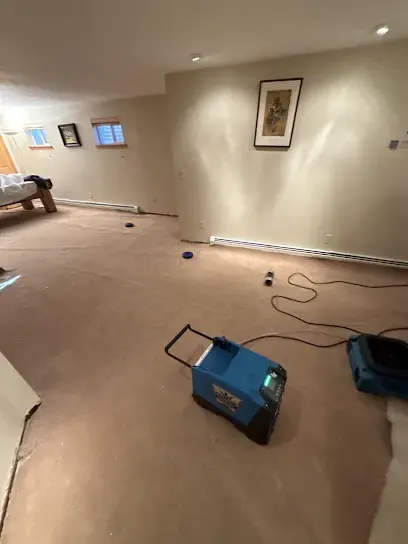
A basement flooding cleanup starts with extraction. Pumps and extractors pull standing water first, then soak the carpet and padding dry.
Storm water counts as contaminated. Carpet, padding and drywall that sat in it are removed, and the exposed floor and framing are cleaned and treated.
Moisture mapping then shows where the water traveled, including into wall bottoms and under stairs.
Drying and readings
Air movers and dehumidifiers run until readings on the slab and framing match a dry reference. Concrete dries more slowly than drywall, so the equipment can run for days.
Each visit adds a reading to the file, which gives the insurer a record of progress.
Storm water and sewer water together
Edgewater is served by Edgewater Sewer and the East Jefferson County Sanitation District. When a storm overloads a sewer, backup water can mix with runoff in the same basement.
The storm and flash flood cleanup page explains how mixed water is handled.
Preparing for the next storm
Edgewater cannot move Sloan's Lake, but owners can lower the damage from a flood. A few steps help before the clouds build.
- Keep window well covers clear and in good shape.
- Store items on shelves or pallets instead of on the basement floor.
- Test the sump pump and keep a battery backup if possible.
- Know how to reach the main water and power shutoffs.
- Keep an emergency kit and the insurer's claim number in one place upstairs.
What renters and landlords should do
With most Edgewater residents renting, a flooded basement is often a landlord's problem and a tenant's loss. Both sides benefit from a clear record.
A tenant should send a written report with photographs, and a landlord should confirm the date that extraction and drying began.
- Keep a copy of every message about the water.
- List belongings that were damaged, with photos.
- Ask whether renter's insurance covers stored items.
- Keep any receipts for hotel stays or equipment.
Signs the ground is already saturated
A basement does not need a storm to take water. After days of rain or a fast snowmelt, the ground around a foundation can hold more water than it can drain.
Damp patches at the base of a wall, a musty smell in a closet or water beading on the floor at the wall joint point to groundwater pressure. Catching these early limits the damage.
Insurance and records
Flood damage from rising water is usually separate from standard homeowners coverage. A renter's policy often works the same way.
Dated photos, readings and a written timeline help in any claim. The Golden area basement flooding cleanup page lists the file items an adjuster tends to ask for.
Questions
Why does Edgewater flood so often?
The city sits in a small valley between the hills of Wheat Ridge and Lakewood, and Sloan's Lake collects runoff from 2,250 acres across several cities.
Will a sump pump stop basement flooding in a major storm?
Not always. In the 1965 flood a basement took about 8 feet of water despite a sump pump that ran continuously.
Is storm water in a basement safe to touch?
No. It can carry soil, bacteria and debris from the street, so it is handled as contaminated water.
Who should be called for a sewer backup in Edgewater?
The East Jefferson County Sanitation District has 24/7 emergency dispatch for backups, and the property owner maintains the sewer lateral to the main.
What does a tenant do after a basement floods?
Report it to the landlord in writing, take photographs and keep a copy of the message. Then ask the landlord or insurer about cleanup.