When sewage comes up through a floor drain, the first reaction is to find someone to blame. In Lakewood, who owns the failed pipe decides who has to fix it, and the answer is often the property owner.
Key takeaways
- Lakewood property owners maintain the entire sewer lateral, from the building to the main under the street.
- The lateral is about half of the whole sewer system, and the city says private laterals cause many backups.
- Lakewood offers 24/7 emergency inspections to decide whether a backup is the owner's or the city's responsibility.
- A backflow prevention valve, a relief valve and a cleanout are the city's recommended protections.
- Sewage is Category 3 water, so porous materials that touched it are removed and the area is treated.
Who owns which pipe in Lakewood
A sewer system has two parts that matter to a homeowner. The main runs under the street, and the lateral runs from the main to the building.
In Lakewood, property owners maintain the entire lateral. The city says that stretch makes up about half of the sewer system.
That means a root blockage, a collapsed section or a broken joint in the lateral is the owner's repair, even when it sits under the front yard or the street.
Who actually serves the property
The picture is more complicated than one city utility. More than 20 independent water and sewer districts serve Lakewood residents.
The City of Lakewood provides its own water and sewer service only in a small part of north Lakewood. Its sewer utility serves about 8,000 customers there.
Green Mountain Water and Sanitation District is one example of a district inside the city. It serves about 9 square miles, was founded in 1951 and sends its sewage to Metro Wastewater Reclamation District.
- Check the sewer bill or ask the district to confirm the provider.
- Neighbors may be on a different district with different contact details.
- The provider decides whether the problem is in the main or the lateral.
Why laterals fail in the Front Range
Lakewood homes have a median year built of 1969 or 1977, so many laterals have been in the ground for decades. Age alone does not break a pipe, but it gives roots, soil and settling time to do their work.
Colorado Geological Survey calls expansive swelling soil the state's most significant geologic hazard. Swelling clays can expand up to 20 percent when wet and push with up to 30,000 pounds per square foot, which can damage slabs, basement floors and sewer pipes.
A lateral that bends or shifts can catch debris, and the next flush or heavy rain backs the system up into the lowest drain in the house.
Clues that point to the lateral
Several fixtures backing up at once, or sewage appearing in the basement while upstairs drains still work, suggests a blockage past the house.
A gurgling toilet after the washing machine drains is another sign that the lateral cannot carry the flow.
Clues that point to the main
If neighbors report the same problem, the stoppage may be in the district main. That is why the emergency inspection matters.
What to do in the first minutes
Sewage backups are a health risk, so the first moves protect people rather than property.
- Keep children, pets and anyone with a weak immune system out of the area.
- Stop using sinks, showers, toilets and the washing machine so more water does not enter the pipe.
- Do not use the vacuum or a fan on wet sewage, which spreads contamination.
- Turn off power to the area if outlets are wet and the panel can be reached safely.
- Call the 24/7 emergency inspection to find out whether the cause is in the main or the lateral.
- Photograph the backup, the drain and everything it touched.
How a Category 3 cleanup differs
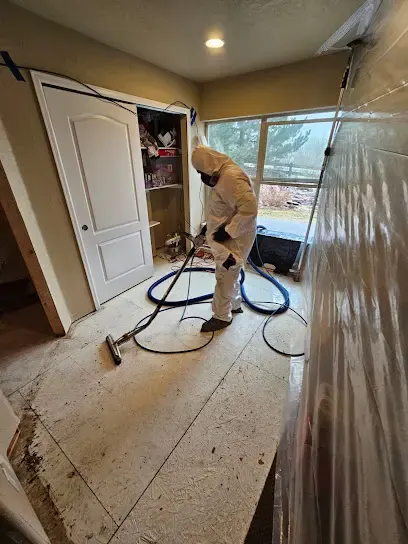
Sewage is Category 3 water, also called black water. It carries bacteria and has to be handled with protective equipment.
A sewage backup cleanup starts with containment, so the affected room is separated from the rest of the house. Standing sewage is then extracted and carried out.
What gets removed
Porous materials that touched sewage are removed and discarded. That usually means carpet, padding, drywall near the floor and cardboard storage.
Cleaning cannot make these materials safe again, which is why removal is the standard instead of an attempt to save them.
What gets cleaned and dried
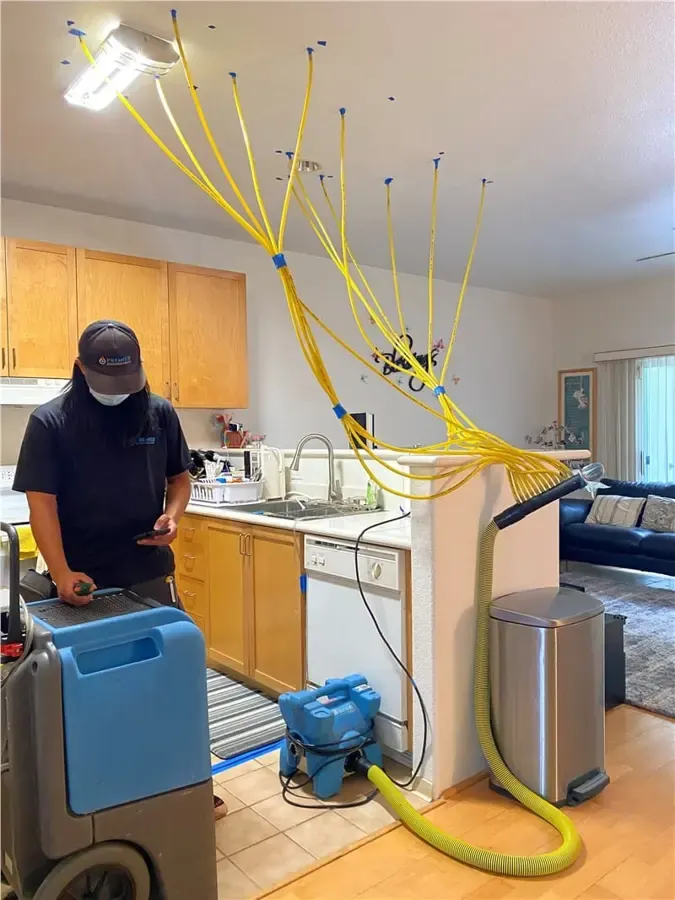
Hard surfaces such as concrete, tile and framing are cleaned and treated with an antimicrobial. Then air movers and dehumidifiers dry the space.
Readings from moisture meters show when the structure matches a dry reference. The cost and timing depend on how far the sewage traveled.
Keeping records for the insurer and the district
A sewage backup claim has a few moving parts: the cause, the cleanup and any repair to the lateral. Each one needs paper behind it.
Many homeowners policies exclude sewer backup unless an endorsement was added, so the first call to the insurer should ask exactly what is covered.
- Note the time the backup began and what was in use at that moment.
- Keep the emergency inspection result and the name of the district or city contact.
- Save the plumber's report on the lateral, including any camera inspection.
- Keep drying logs, readings and photographs from the cleanup.
- Do not throw away damaged items until the insurer has seen photos of them.
Backflow valves, relief valves and cleanouts
The city recommends three fixes that lower the risk of a repeat backup. They are small compared with a basement full of sewage.
- A backflow prevention valve keeps sewage from flowing back into the house.
- A relief valve gives pressure a way out when the system is overloaded.
- A cleanout gives a plumber a place to clear a blockage without opening the floor.
When storm water adds to the problem
Heavy rain can overload a sewer system in older areas and push water into basements. Lakewood gulches such as Weir Gulch and Lakewood Gulch carry runoff through the city.
When rain, a gulch and a blocked pipe combine, the water in a basement may be a mix of sources, and the whole mixture is treated as contaminated. A storm and flash flood cleanup follows the same Category 3 steps.
The main sewage backup cleanup page explains the process from containment to final readings, and the storm flood cleanup page covers the runoff side.
Living with the risk after the cleanup
A backup that happened once can happen again if the cause is not fixed. A camera inspection of the lateral shows roots, breaks and sags that are otherwise invisible.
The lowest finished space in the house is the most exposed, so storing valuables and electronics above the floor in a basement is a simple precaution.
Questions
Who pays to fix a sewer lateral in Lakewood?
Lakewood property owners maintain the whole lateral from the building to the main under the street, so the repair is normally the owner's cost.
How is a backup in the main handled?
If the emergency inspection finds the blockage is in the main, the city or the district that owns it clears it. The cleanup inside the house is still needed.
Can sewage water be dried and kept?
Hard surfaces can be cleaned, treated and dried. Carpet, padding and soft drywall that touched sewage are removed.
Does homeowners insurance cover sewage backup?
Often only with a specific endorsement. The policy and the insurer decide, so ask early and keep photos and readings.
What does a backflow prevention valve do?
It lets sewage flow out of the house but not back in, which protects the lowest drains during a main backup.