Structural Drying in Arvada, CO
Surfaces in an Arvada house can feel dry while the framing and subfloor behind them stay wet. The drying team maps the moisture, sets equipment to match the loss and keeps it running until the meters agree.
(888) 532-8620Dry an Arvada house to readings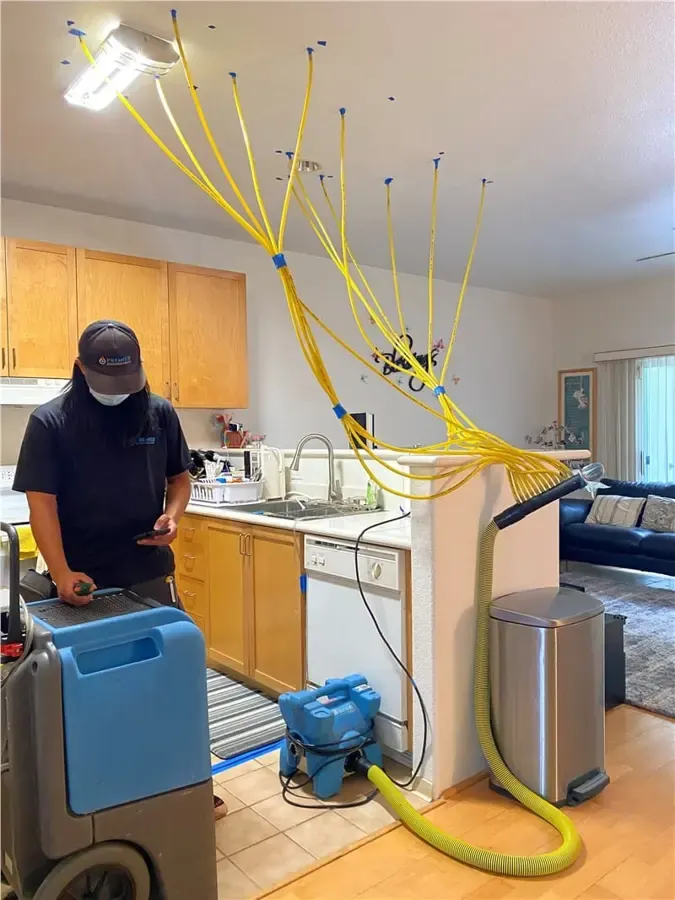
Much of Arvada's housing dates to the 1960s through 1980s, when the population climbed from 19,242 to 84,576, and newer master-planned areas like Candelas add recent construction. Both kinds of house hold water in framing, subfloor and wall bays long after the floor looks fine.
First steps for structural drying and dehumidification in Arvada
- 1
Document first
Photograph wet areas before furniture or flooring is moved.
- 2
Open the air
Run a fan or crack a window if the area is dry and safe.
- 3
Leave wet walls alone
Skip heat guns and vacuums on soaked drywall.
- 4
Call for readings
Meters find moisture a hand cannot feel.
What does structural drying and dehumidification cost in Arvada, CO?
Structural drying in Arvada, CO usually lands between $1,000 and $10,000. Class of loss, floor area, the number of dehumidifiers and air movers, and the days on site all move the figure up or down within that range.
Light loss, one area
- Fans in the wet zone
- Single dehumidifier
- Checks each visit
Several rooms
- Extra LGR units
- Airflow through wall bays
- Thermal imaging
Dense materials
- Desiccant or injection methods
- Longer run time
- Detailed logs
Ranges are typical, not a quote: category of water, square footage, material class and how fast drying started move the number most. Run the water damage cost calculator for a closer range.
How structural drying and dehumidification is handled in Arvada
The tech who does the walkthrough maps moisture before any equipment goes down, so the drying plan matches what is actually wet. Equipment stays until the readings say dry, not until it looks dry.
Map the moisture
Meters and a thermal camera show which materials are wet.
Set the equipment
Air movers and dehumidifiers are sized to the class of loss.
Check each day
Readings are logged and gear is repositioned as they fall.
Release the job
Equipment leaves only after the dry reference is met.
Planning the equipment
The team starts by classing the loss and mapping wet materials with a moisture meter and a thermal camera. That map sets how many air movers and dehumidifiers go in, where they sit and which cavities need a hole for airflow.
- Class 1 to 4 sets the equipment count.
- Wet bays get small openings or injection drying.
- Equipment is moved as the readings fall.
- Thermal camera scans catch wet spots a meter can miss.
Letting the meter call it dry
A wall can look finished by day two and still sit well above a dry reference. Readings are logged each visit, compared with an unaffected area of the same material, and drying ends only when they land within the S500 range.
- Meter values recorded for the same spots each day.
- A dry reference taken from untouched framing.
- Equipment pulled only after the final pass.
Where drying meets other jobs
Drying usually follows water extraction, because standing water has to leave before air can do its work. Winter freeze breaks are covered under frozen pipe cleanup, and a wet lower level is dealt with in basement flooding cleanup. Each one ends with the same test: the meter, not the eye.
Structural drying and dehumidification across Arvada and nearby towns
The drying team covers Arvada ZIP 80002, 80005 and 80006, from Westwoods Mesa, Meadowglen and Whisper Creek to Spring Mesa, Pomona Lakes and the Candelas master-planned community.
The same service nearby: structural drying and dehumidification in Golden, Wheat Ridge, Westminster.
Related water damage services in Arvada
Structural Drying and Dehumidification questions in Arvada, CO
How do I know walls are still wet?
A meter reads moisture behind paint and drywall. Cool spots, a musty smell or swollen baseboards also suggest that water remains inside the cavity.
Why not rely on open windows and fans?
Colorado air is dry, but wet framing and subfloor release water slowly. Dehumidifiers pull it out, and fans alone can push moisture into other rooms.
Do older Arvada houses dry differently?
Density, flooring and insulation vary from house to house, so the meter, not the age of the home, sets the plan.
How long will the equipment stay?
Most jobs wrap up in three to five days, though hardwood and concrete can run longer. Daily readings show when it is done.
Can the equipment run on a normal circuit?
Usually, the team spreads the load over several circuits and tells you which outlets to leave alone.
Will insurance pay for drying?
A sudden covered cause, such as a burst pipe, normally brings drying into the claim. Ask your own insurer to confirm.
Walls still damp? Get the drying started.
Dry-feeling surfaces mislead. Equipment stays on site until the meters report the framing dry.
(888) 532-8620Arvada drying, around the clock- Dispatch around the clock
- IICRC S500 drying standard
- Moisture logs for the claim file
- Find us on Google