Structural Drying and Dehumidification in Wheat Ridge, CO
Water that soaked a Wheat Ridge house does not leave on a schedule. The drying team sets dehumidifiers and air movers by the class of loss and keeps them running until the readings, not the calendar, say the structure is dry.
(888) 532-8620Wheat Ridge structural drying now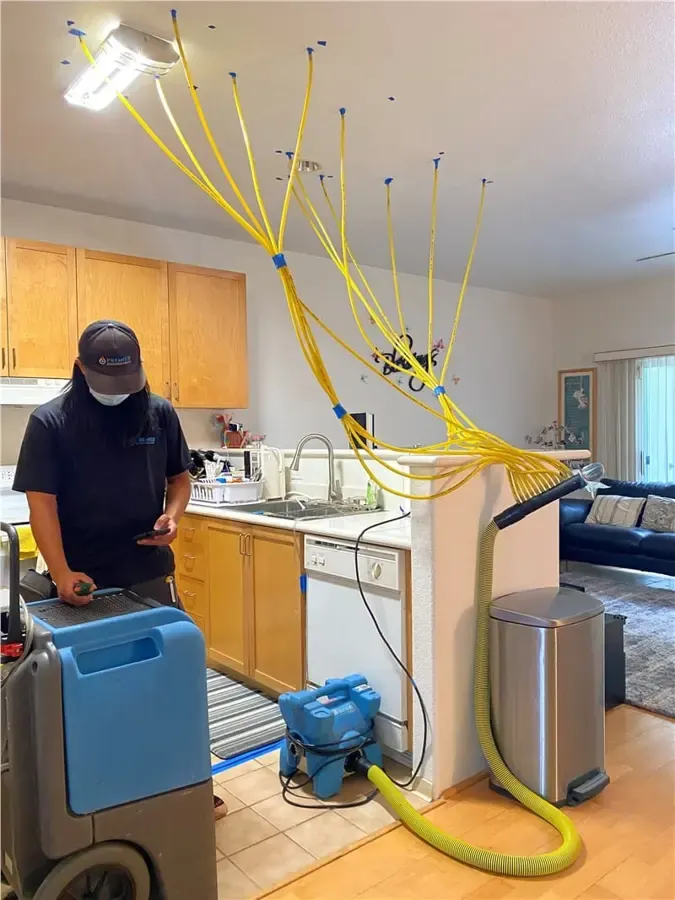
Drying a building is measuring, not guessing. A surface can feel dry while the framing behind it still holds enough water to warp a floor or feed trouble later, so the readings have to prove it.
First steps for structural drying and dehumidification in Wheat Ridge
- 1
Find the wet limit
Check neighboring rooms and floors, not only where water is visible.
- 2
Hold off on demolition
Let the readings decide any wall cutting.
- 3
Give the crew access
Clear furniture and keep doors and closets open for airflow.
- 4
Keep machines running
Leave the equipment on and call if one stops.
What does structural drying and dehumidification cost in Wheat Ridge, CO?
Structural drying in Wheat Ridge, CO typically runs $1,000 to $10,000, depending on the class of loss, the square footage, how much equipment is needed and how many days the materials take to reach the goal.
Class 1 to 2, one area
- Air movers
- One dehumidifier
- Daily readings
Class 3, several rooms
- Multiple dehumidifiers
- Wall and floor drying
- Moisture mapping
Class 4, dense materials
- Injection drying
- Desiccant units
- Extended monitoring
Ranges are typical, not a quote: category of water, square footage, material class and how fast drying started move the number most. Run the water damage cost calculator for a closer range.
How structural drying and dehumidification is handled in Wheat Ridge
The tech who does the walkthrough maps moisture before any equipment goes down, so the drying plan matches what is actually wet. Equipment stays until the readings say dry, not until it looks dry.
Set the reference
A dry reading from the same house sets the target.
Place the equipment
Air movers and LGR dehumidifiers go where the meters point.
Monitor daily
Readings on framing, subfloor and drywall are logged each visit.
Release the equipment
It leaves only when every material reaches the goal.
How a drying plan is built
The plan starts with the class of loss, which sets how many air movers and dehumidifiers the structure needs. Wheat Ridge sits at about 5,348 feet and Front Range air is often dry, but a closed-up wet house still holds humidity, so equipment is sized to the water in the building, not the weather outside.
- Class 1 and 2 losses involve limited wet material.
- Class 3 losses soak ceilings, walls and floors from above.
- Class 4 losses involve dense materials such as hardwood and concrete.
Why readings decide when it is dry
A dry reference is taken from unaffected material in the same house, and the goal is within 2 to 4 points of it. Daily readings on framing, subfloor and drywall show when each material gets there. Time alone proves nothing, and equipment pulled early can leave water in the structure.
- Moisture meters on drywall, framing and subfloor.
- Thermal imaging to find water behind finished surfaces.
- Injection drying into wall cavities and under floors where needed.
Drying older homes and clay soil
Many Wheat Ridge homes date to the 1960s, so drying is verified with readings rather than assumed. The Colorado Geological Survey also notes swelling clay along the Front Range, a reminder that soil near a foundation holds moisture. See water extraction for the step before drying and the drying time estimator for a rough schedule.
Structural drying and dehumidification across Wheat Ridge and nearby towns
The Wheat Ridge structural drying crew covers ZIP 80033, 80034 and 80215, from Olinger Gardens and Clearvale out to Garrison Lakes and along the Clear Creek corridor.
The same service nearby: structural drying and dehumidification in Golden, Edgewater, Arvada.
Water damage restoration in Wheat Ridge · every town covered
Related water damage services in Wheat Ridge
Structural Drying and Dehumidification questions in Wheat Ridge, CO
How do I know a house is dry?
Moisture meters compare each material with a dry reference from the same house. The goal is within 2 to 4 points of it, and the drying team logs the numbers daily.
Why not use a regular fan?
A fan moves air but does not remove moisture. LGR dehumidifiers pull water out of the air so more can leave the materials.
How long do the machines run?
Three to five days is typical, and longer for dense materials. They stay until readings say the structure is dry.
Does a dry climate make drying faster?
Outdoor air along the Front Range is often dry, but a closed-up wet house still holds humidity, so dehumidifiers do the real work indoors.
Will the equipment raise my power bill?
Somewhat, because dehumidifiers and air movers run around the clock. The drying team can note the added use for the claim.
Does insurance pay for structural drying?
When water damage is sudden and covered, drying is usually part of the claim. The policy sets the limits, so confirm with your own insurer.
Need a Wheat Ridge house dried properly? Start now.
Wet framing and subfloors can look dry long before they are. The drying team measures, dries and proves it with readings.
(888) 532-8620Wheat Ridge drying crew, 24/7- Dispatch around the clock
- IICRC S500 drying standard
- Moisture logs for the claim file
- Find us on Google