Structural Drying and Dehumidification in Edgewater, CO
Older Edgewater houses hide moisture in plaster, old framing and layered floors. The drying team maps where it went, sets up fans and LGR dehumidifiers and leaves them on until readings match a dry reference.
(888) 532-8620Start Edgewater structural drying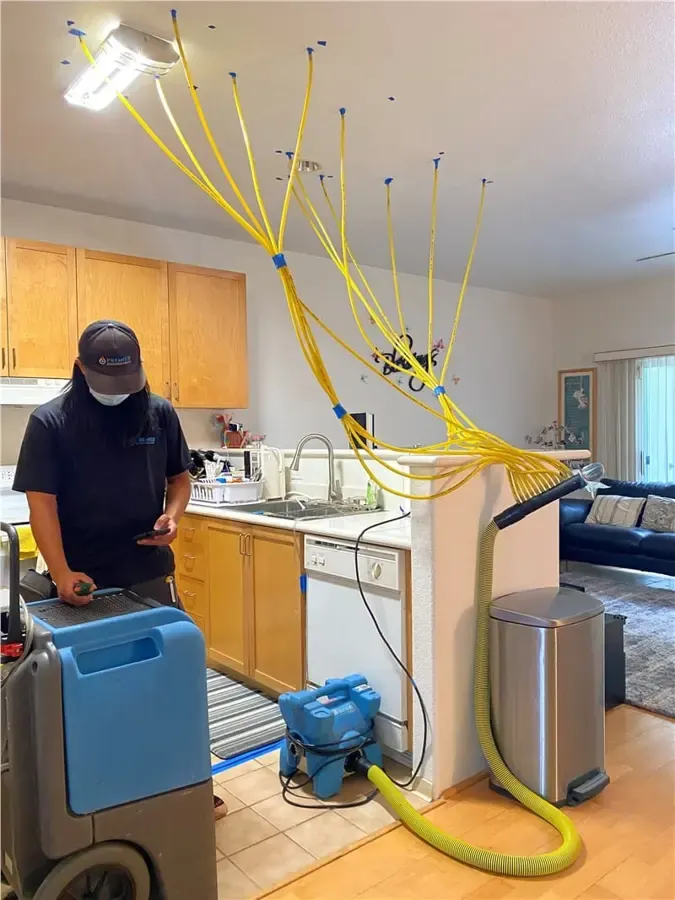
Surfaces dry first and mislead. A floor can feel fine while the subfloor beneath it holds water, and drying has to reach every layer. In an older Edgewater house, there are more layers than most people expect.
First steps for structural drying and dehumidification in Edgewater
- 1
Fix the water source
Repair or shut off whatever is still leaking.
- 2
Keep the heat on
Warm rooms dry faster, so leave the thermostat where it is.
- 3
Let the equipment run
Switching it off early leaves moisture in the framing.
- 4
Ask for the daily log
Moisture, humidity and temperature numbers show progress.
What does structural drying and dehumidification cost in Edgewater, CO?
Plan on $1,000 to $10,000 for structural drying in an Edgewater house. Loss class, floor area, equipment count, from dehumidifiers to air movers, and the days the materials need to reach the goal set the figure.
Light loss, one area
- A few fans
- Single dehumidifier
- Daily logs
Class 3, several rooms
- Cavity drying
- More dehumidifiers
- Humidity records
Class 4, dense materials
- Desiccant drying
- Hardwood mats
- Extended monitoring
Ranges are typical, not a quote: category of water, square footage, material class and how fast drying started move the number most. Run the water damage cost calculator for a closer range.
How structural drying and dehumidification is handled in Edgewater
The tech who does the walkthrough maps moisture before any equipment goes down, so the drying plan matches what is actually wet. Equipment stays until the readings say dry, not until it looks dry.
Map and classify
Meters set the class and the plan.
Set the equipment
Fans and dehumidifiers go where the meters found water.
Read daily
Moisture, temperature and humidity go in the log.
Release at the goal
Gear leaves only after readings come down to the target.
Building the drying plan
Every plan begins by classifying the loss, which depends on how much water reached walls and floors and how dense the materials are. About 28.3 percent of Edgewater housing predates 1950 and another 38.8 percent dates from 1950 to 1969, so plaster, dense framing and older floors often call for more equipment and more days. Placement follows the moisture map, not a formula.
- Air movers sized to the wet surface area.
- LGR dehumidifiers matched to the volume of air.
- Desiccant units or mats for dense materials.
Why meters decide when drying ends
Edgewater's semi-arid climate gives it over 300 sunny days a year, but outdoor air does not dry a closed-up house. Pinless meters, thermal imaging and humidity readings are taken every day, and equipment stays until each material reads close to the dry reference.
- Daily logs for moisture, temperature and humidity.
- Cavities checked without tearing out sound walls.
- Equipment reduced as areas reach the goal.
Where drying fits after other losses
Structural drying follows nearly every loss. See water extraction for the step before it and frozen pipe cleanup for a winter source. The drying time estimator gives a rough timeline.
Structural drying and dehumidification across Edgewater and nearby towns
The drying team covers ZIP 80214, from the Sloan's Lake area and 25th Avenue to Citizen's Park, Sheridan Boulevard and 20th Avenue, in older houses and rentals alike.
The same service nearby: structural drying and dehumidification in Golden, Wheat Ridge, Lakewood.
Related water damage services in Edgewater
Structural Drying and Dehumidification questions in Edgewater, CO
Why can drying take more than a day or two?
Water leaves dense materials slowly, and every layer has to reach a dry reading before anything is closed up.
Does outdoor dry air speed up an indoor dry-out?
Not much. A sealed house holds humidity, so dehumidifiers do most of the work even where the climate is semi-arid.
Is it possible to dry a wall without cutting it open?
Often. Small holes and injection drying reach the cavity, and larger openings happen only when meters call for them.
What makes the drying equipment so noisy?
Air movers and dehumidifiers run at high volume to push moisture out of the structure and into the air stream.
What does dry reference mean?
It is a reading from unaffected material in the same house, used as the target for the wet material.
Will insurance cover the drying itself?
It is usually part of the water damage claim. Ask your insurer how the readings and logs should be documented.
Moisture still in the framing? Begin drying.
A surface can look dry while the framing is not. The crew keeps equipment on until the numbers say dry.
(888) 532-8620Edgewater dry-out crew, 24/7- Dispatch around the clock
- IICRC S500 drying standard
- Moisture logs for the claim file
- Find us on Google