Structural Drying in Lakewood, CO
Surfaces dry first and fool people, while studs and subfloor stay wet. The drying team builds a plan from moisture maps, sets equipment by class and keeps it running until the readings match a dry reference.
(888) 532-8620Start Lakewood structural drying now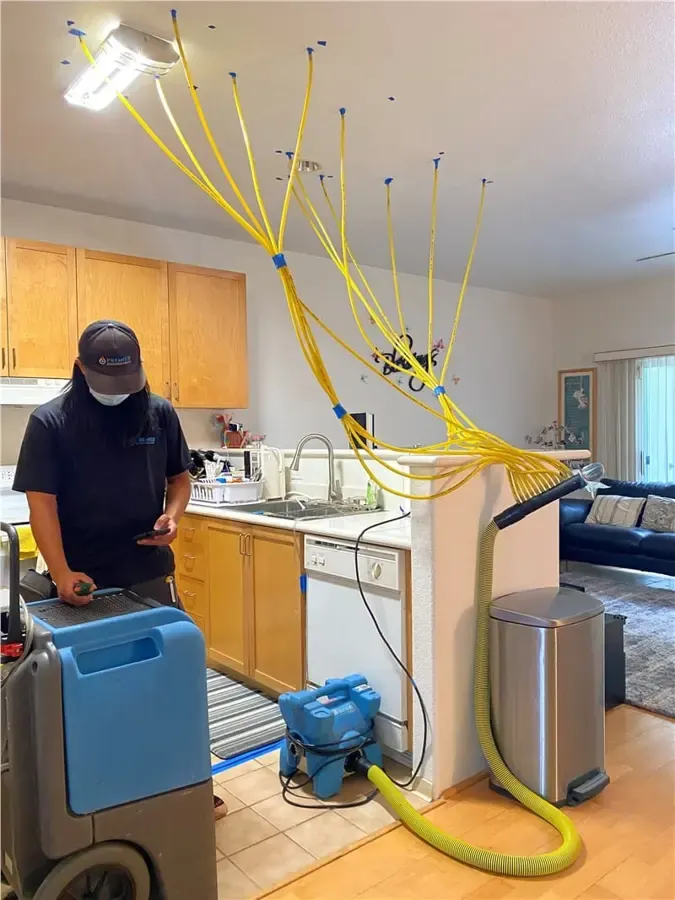
Structural drying is the part of a water loss that nobody sees. Floors can look dry in a day while studs, subfloor and wall cavities keep holding water, and that hidden moisture is what warps framing and grows mold later.
First steps for structural drying and dehumidification in Lakewood
- 1
Stop the water
Close the source valve so nothing new soaks in.
- 2
Leave the airflow to the crew
The drying team sets fans and machines to move air the right way.
- 3
Mark the wet spots
Note damp walls or floors with a strip of tape.
- 4
Call early
The sooner drying starts, the less has to be removed.
What does structural drying and dehumidification cost in Lakewood, CO?
Structural drying in Lakewood, CO generally runs $1,000 to $10,000. Class of loss, wet square footage, equipment count and the number of days needed to reach the dry goal move the price.
Light loss, one area
- Air movers placed
- One LGR dehumidifier
- Readings each day
Heavy wetting, several rooms
- Wall cavity drying
- More dehumidifiers
- Temperature and humidity logs
Dense materials
- Desiccant units
- Mats on hardwood
- Longer monitoring
Ranges are typical, not a quote: category of water, square footage, material class and how fast drying started move the number most. Run the water damage cost calculator for a closer range.
How structural drying and dehumidification is handled in Lakewood
The tech who does the walkthrough maps moisture before any equipment goes down, so the drying plan matches what is actually wet. Equipment stays until the readings say dry, not until it looks dry.
Map it
Meters and thermal imaging show every wet material.
Set equipment
Air movers and dehumidifiers go in sized to the class of loss.
Monitor daily
Readings and humidity are logged and equipment adjusted.
Release
Machines come out when materials match the dry reference.
How a Lakewood drying plan is built
The plan starts with the class of loss, which describes how much water wet the building and how porous the materials are. Lakewood housing runs from 1920s craftsman houses in Two Creeks to Green Mountain Village homes built from the 1960s to the 1990s, so plaster, hardwood and newer drywall each get equipment chosen for them.
- Air movers for evaporation across surfaces.
- LGR dehumidifiers to pull moisture from the air.
- Desiccant units for dense materials like hardwood.
Why readings decide when it is dry
Touch can lie, so the crew compares each material to a dry reference from an unaffected part of the same house. Equipment leaves when wet materials read within 2 to 4 points of that reference, and not before. Readings are logged every day, which gives the adjuster a record.
- Pinless meters on walls and floors.
- Thermal imaging for hidden pockets.
- Daily logs of temperature and humidity.
When drying follows extraction or removal
Drying starts after water extraction takes out the standing water, and after any Category 3 materials are removed. Use the drying time estimator for a rough timeline, and see basement flooding cleanup for lower-level losses.
Structural drying and dehumidification across Lakewood and nearby towns
Drying plans cover Two Creeks, Green Acres, Green Mountain Village and the Belmar area, along with the rest of the city, across ZIP 80227, 80228, 80232, 80214, 80215 and 80226.
The same service nearby: structural drying and dehumidification in Golden, Edgewater, Wheat Ridge.
Related water damage services in Lakewood
Structural Drying and Dehumidification questions in Lakewood, CO
Why not just run fans?
Fans move air but cannot pull moisture from framing or subfloor. Dehumidifiers matched to the loss are what finish the job.
How is the house proven dry?
By comparing wet materials with a dry reference from the same house and waiting until they read within 2 to 4 points.
Does a dry feel mean it is dry?
No. Surfaces dry first, and studs and subfloor can stay wet behind them.
Are older Lakewood homes harder to dry?
They can be. Plaster, hardwood and thick framing hold water longer, and a 1920s Two Creeks house may need desiccant units where a newer one does not.
How long does structural drying take?
Usually three to five days, longer for dense materials or multi-level losses.
Is drying covered by insurance?
When the loss is sudden and covered, drying is typically part of the claim. Your policy decides, so check with your insurer.
Damp inside the walls? Get the dehumidifiers running.
Dry-feeling floors can hide wet framing. The crew keeps machines on until the meters agree.
(888) 532-8620Lakewood dry-out crew, 24/7- Dispatch around the clock
- IICRC S500 drying standard
- Moisture logs for the claim file
- Find us on Google